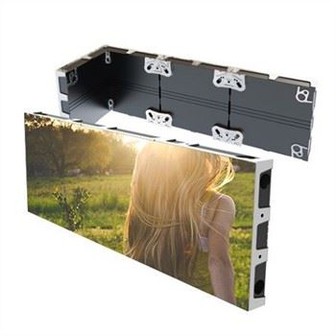
What Is The Front&Rear Maintenance LED Display?
What is the Front&Rear Maintenance LED Display?
1. Rear Maintenance
Rear maintenance is performed from the back of the LED display cabinet, the rear of the LED display cabinet have door-like openings, has a door that opens using a key, the internal structure of the layout can be seen after opening the led cabinet. This system is the most common and we find it in both indoor and outdoor screens.

Rear maintenance advantages
The price is slightly lower,the inspection and maintenance are convenient and efficient. It is not suitable for inlaid or wall mounted installations because if any failure occurs as it can’t be repaired from the back.
For those large LED displays installed on the exterior walls of buildings, maintenance channels must be designed so that maintenance personnel can perform maintenance and repairs from the back of the screen.

Rear maintenance applicable scenarios
Building roofs, road pillars and large -screen display screens are all available and are mostly used outdoors.
2. Front Maintenance
Maintenance and inspection are carried out from front of LED cabinet. In installations where the LED screen is placed on a wall or facade, the LED screens must have a frontal access system, since once installed, it is not possible to access the internal part of the screen from behind. There are three front maintenance designs:
System with front screws
In this case, the modules and LED plates are attached to the cabinets through screw attached to the front.This system is very safe, reliable and perfect for outdoor installations, although it is somewhat more laborious at the time of installation.
System with a lock mechanism
In this case, the led modules are connected to the structural LED cabinets by means of a closing and opening system similar to a basic lock. From the front we have openings where we insert a simple key and turn to release the LED module.

Magnetic design
This new system is the one that currently being used more for front access LED screens. It doesn’t need to assemble the wire, it’s simple and convenient, supports quick maintenance work. To remove it from the front of the screen, you only need to use a magnetic adsorption tool that will allow you to remove the magnet LED module from the front of the screen.

Front maintenance advantages
The LED screen cabinet can be made lighter and thinner, saving space, light and beauty, and the disassembly of the LED module is also more convenient and efficient.
LED displays installed indoors usually adopt wall-mounted structure, so the space is extremely precious, so there will not be too many places as maintenance channels. The front amintenance can greatly reduce the overall thickness of the LED display structure, not only good integrating with the surrounding built environment; the effect is guaranteed while saving space.
Front maintenance applicable scenarios
Conference display, security monitoring display, control and command center display, indoor small-pitch display,etc.
Conclusion:
In summary, for different application environments and practical needs, flexible use of front access and rear access is needed to better and faster solve LED screen failure problems. Of course, technical support is also need. Incompatibility and mismatch in the operation process should be avoided during the maintenance process.